

You don’t need another habit
We’re getting more done, but at what cost?

Last summer, my family and I went to an all-inclusive resort. I’ve never done anything like that before. My husband and I are not really all-inclusive resort people, but we decided to give it a go as a way to potentially reduce some of the logistics of going on holiday with two children. Also, my mother-in-law was joining us and it was her 80th birthday so we decided to push the boat out. I had always thought I’d hate a holiday like that but after years of trying and failing to have what felt like a proper break, I was really ready to be proved wrong. But while the hotel facilities were lovely, and was nice to not have to cook and wash up, the routine of it almost sent me mad. Every morning and evening we’d go for breakfast and dinner and be directed to “our table” where everyone would gravitate towards the same seats they’d sat in the day before, and the day before.
“Let’s not sit in the same seats, guys, let’s mix it up a bit, go a bit crazy hahahaha,” I’d say with a manic glint in my eyes. They’d look at me like I was mad. What difference does it make, after all? I don’t know. My reaction was entirely visceral. All I know is I could not sit in the same seat at the same table in the same room every day for two weeks; I simply could not do it.
I am not a “creature of habit".” And yet I must be. Almost all of us have habits. They function as an adaptive behaviour that for the most part serve us well: putting on your seatbelt, washing your hands after using the toilet, saying “nice” after seeing or hearing the words “sixty nine.” But some of us are clearly more habitual than others.
Let’s think. It’s Wednesday morning. If you’re anything like me you will have got up, gone for a wee, checked your horoscope and your LinkedIn, had a shower and brushed your teeth, got dressed, put a wash on, taken your eight-year-old to the school bus stop, come home, made and eaten breakfast, made a second breakfast for your four-year-old, taken your various supplements, scrolled your phone for ten minutes, made and drunk an espresso, brushed your four-year-old’s teeth and helped her get dressed, brushed her hair and put sun cream on her, filled her water bottle, put some snacks in her bag for later, put her sandals on and sent her out the door with her dad.
How many of those behaviours were a conscious decision and how many were done automatically, because it’s the routine? When I look at my own list, I would say of the twenty-or-so behaviours listed, about 25% of them were habitual, which is to say I didn’t really think about them, I just did them. This, it turns out, is quite a lot lower than the average. Now, one explanation for this is that I spend a lot of my time interacting with children and you truly never know what they’re going to throw at you (Related: My eight-year-old recently explained chaos theory to me and it blew my mind, not just because an eight-year-old was explaining chaos theory but also because ohmygod, guys, it’s so beautiful!). But another explanation is that I just suck at habits.
I remember having a conversation with Hannah Witton in which she talked about her love of cultivating habits. Unfortunately, I cannot for the life of me remember when or why we had this chat so apologies, Hannah, for the unsourced quote I’m about to attribute to you. It might have been for a feature I was writing, a podcast (hers or mine!) or maybe we were just having coffee and catching up, but I distinctly remember her talking about it in the context of condom use. The argument was that if you can making putting a condom on before sex a habit, something that is almost muscle memory, this will help you avoid ever being in a situation where you forget. “You wouldn’t forget to brush your teeth,” she pointed out. “Even if you come home drunk, you still brush your teeth.” (I mean, yes. I do. I am sure there are people who don’t. But you see the logic.) Hannah writes and speaks a lot about organisation and productivity—not in a toxic way, just in a “I got shit to do” way—and it’s easy to see how habits can support those things so I’ve thought about it a lot over the years. I’ve read all the articles on habit-forming, devoured the lists of habits that will make you fitter, happier, more successful, age better. I’ve researched habit stacking and friction reduction. Christ, I even considered buying Atomic Habits (until I read this brilliant take-down of it). I’ve thought about what habits I could cultivate to make my life feel easier, less overwhelming, and for the most part I have come up short.
I am almost laughably bad, it turns out, at cultivating habits. Not because I lack discipline—in fact I’d say it’s almost the opposite because one of the key arguments in favour of habits is that they don’t require willpower because you’re doing them automatically. No, the reason I am bad at cultivating habits is because I’m a brat. It doesn’t matter how often I do something, how ingrained it starts to feel, at some point my brain will go “Shan’t!” and it’ll all collapse. My dentist once told me it takes three months to build a habit and so I did it. I flossed every single day for three months. Then I did six. I even came home drunk on New Year’s Eve and flossed. “That’s it!” I thought. “I’ve done it! I’m now a person who flosses. Superiority complex unlocked.” And then one day I couldn’t be arsed and so I didn’t and that was the end of that.
This isn’t a flex, flossing is really important. I truly wish I could just smooth brain my way to doing it but apparently I am doomed instead to have an argument with myself about it every bloody evening for the rest of my life. Still, I admit that when I saw this study, from 2025, written up in the British Psychological Society newsletter, I felt a flicker of vindication.
The study showed that two thirds of our everyday behaviours are habitual—a larger percentage than previously estimated. Rather than being conscious choices, they are done automatically because the situation triggers them. In lots of ways that’s a positive. Forming habits allows those behaviours to occupy less headspace and require less energy, which not only makes it more likely we’ll keep them up, but frees us up to concentrate on other more interesting things. But on the flip side, that’s an awful lot of your life to be living on autopilot.
I should say that the BPS framing of it does not really tally with the researchers’. To the study’s authors, the findings demonstrate that “almost all behaviours can be supported by habit,” and that’s probably true. But it made me wonder how desirable it really is. I’ve written about the curse of optimisation culture before, and I’ve also written about resisting social media, and the attention economy, but since reading this article, I’ve been thinking a lot about how these things are linked.
When behaviours become habitual, we are, by definition, not paying attention. And not paying attention is deleterious to our experience of the world and thus our happiness. Attention, as I wrote in 2024, is what expands our horizons and enriches our experiences. Without it, life feels flat and smooth. Easier to navigate, maybe, but over time, pretty joyless.
Do we really want to turn our lives into frictionless system? I don’t. I mean, yes, in the context of dental hygiene, I concede it would be useful. But beyond that I’m not sure. It seems profoundly at odds with everything that is wild and interesting and silly and beautiful about life. Also, it closes your eyes to the potential novelty of a situation. I’m not saying your morning piss has to become a mindful experience, I’m just saying it could.
I haven’t come here today to suggest that all habits are bad, or that wanting to cultivate them is boring. But I wonder if they are currently enjoying an outsize reputation in our productivity-obsessed culture. And whether we might, in dropping a few of them, claw back a little more purpose, a little more meaning.
When David Hockney died two weeks ago, I kept thinking about the things he said over the course of his life about the intensity and intentionality with which he looked at the world: “The world is very, very beautiful if you look at it. But most people don’t look very much, do they?”
I don’t want to live my life on autopilot. If I have to keep making people switch seats around the dinner table to achieve that then so be it.
Really Good Tomatoes is a newsletter about culture and human behaviour for people who refuse to be fobbed off with crap tomatoes.

I promised you a pic of my outfit from my sister’s wedding last week but it turns out nobody took any pics of me (outrageous) so I thought I’d share this pic instead of an outfit I wore out to a birthday drinks on Saturday. I bought this dress in the sale over a year ago but it needed altering which took me ages to get around to and so this was its first outing and wow. I’m not someone who gets her tits out a lot so I was not prepared for the level of attention. Ngl, guys, I loved it! I said on Mag Hags last autumn that I “barely think about my boobs these days” versus my early twenties when I thought about them a lot, along with all the other parts of what I believed to be my deeply unsatisfactory body. *cries in Y2K*
But hey, maybe I’m gonna start.
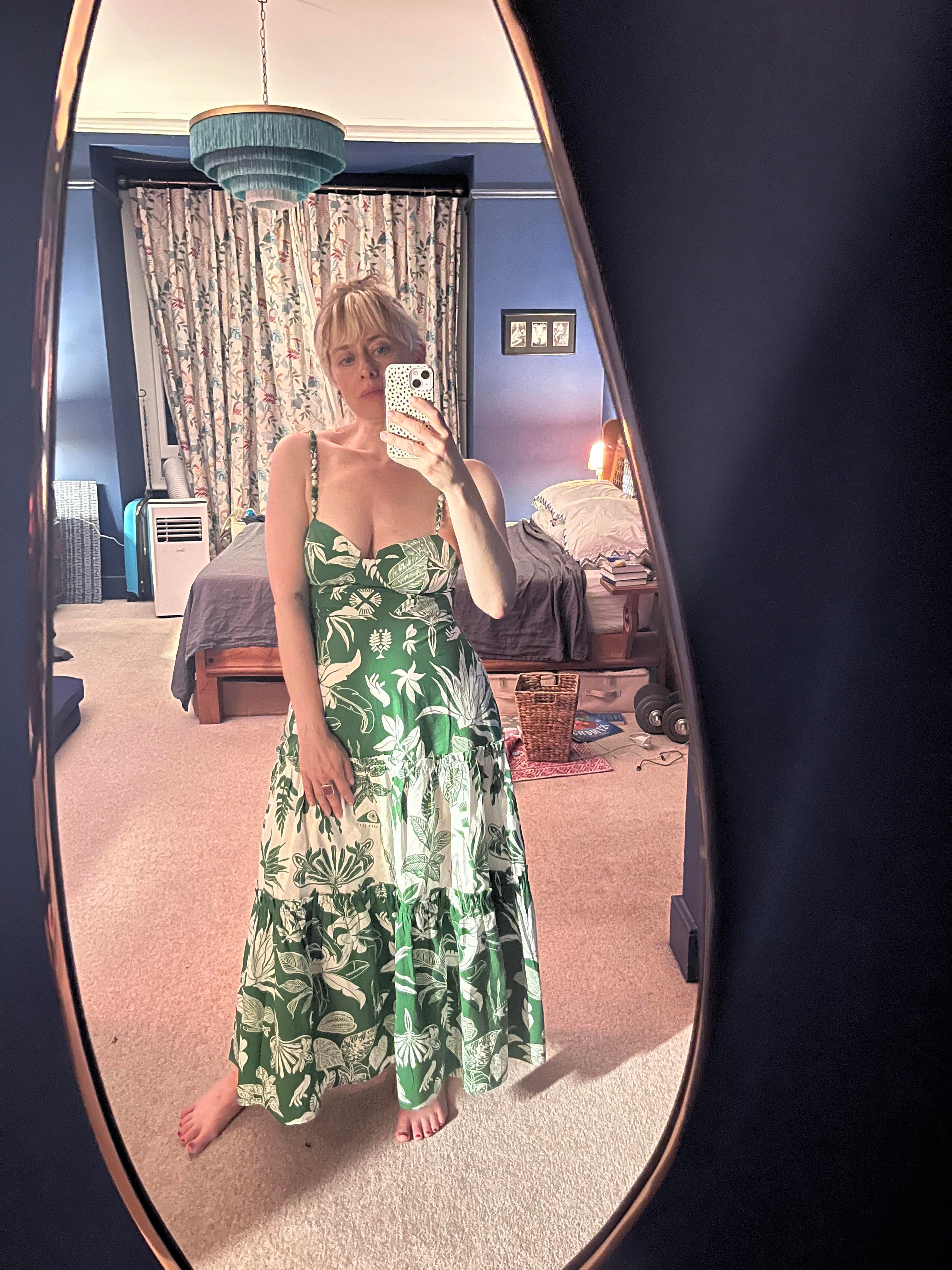
P.S. Please don’t judge me for having an AC unit. My husband panic-bought it when our daughter was a newborn and it was 40 degrees and I was livid at the time but every summer that’s passed since I’ve been forced to concede it was a good investment. Also we have solar panels so we’re not draining the grid. And when it gets hot like last week, we all sleep in one room - the kids love it, it’s basically camping in mummy and daddy’s room.
See you next week!
About Franki
I’m an award-winning journalist, writer, editor, and producer interested in culture, human behaviour, and the way we live. Want to hear more from me?